
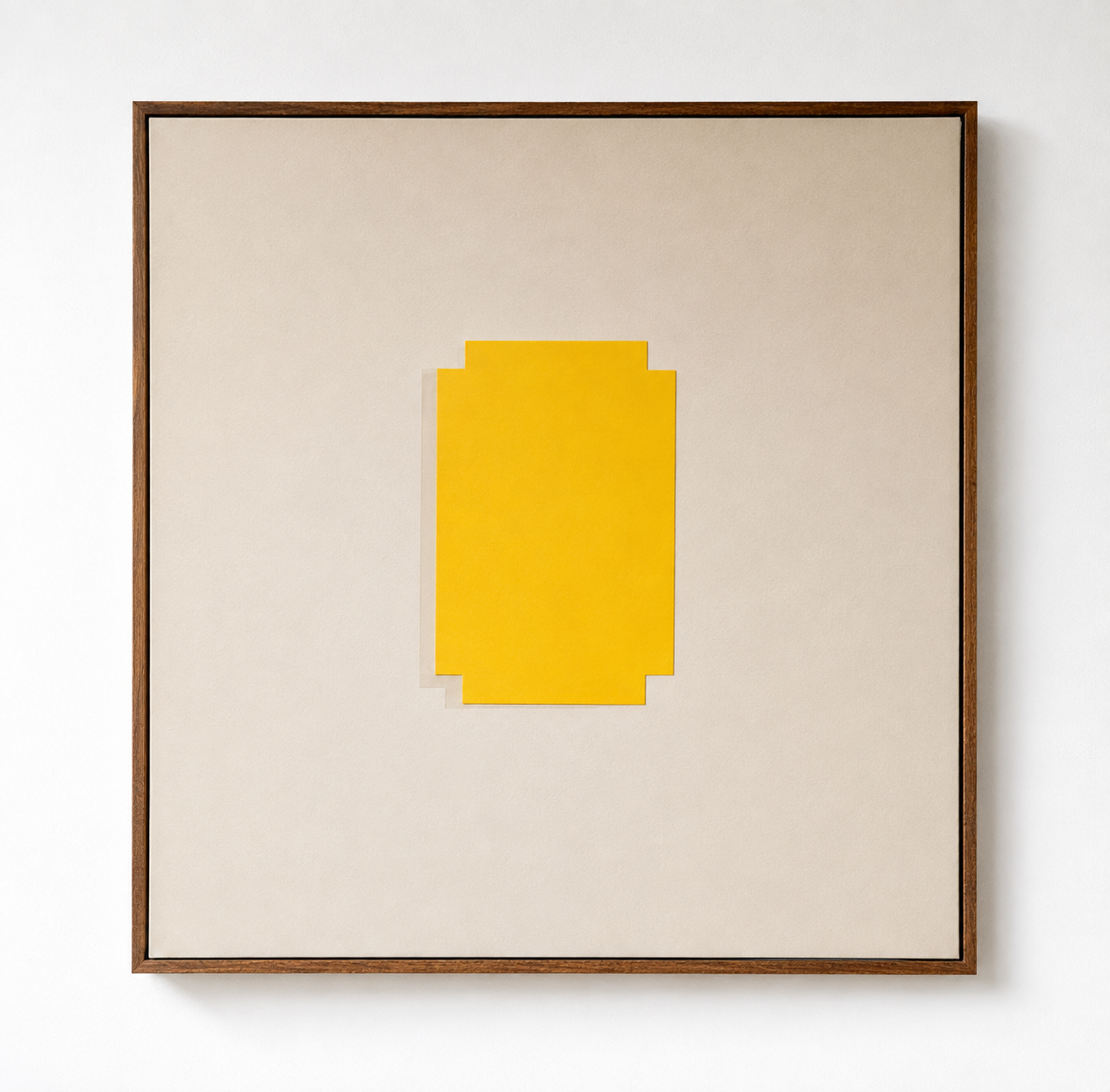
B A K E A N
18 SEPTEMBER – 22 OCTOBER 2026
OPENING RECEPTION FRIDAY · 18 SEPTEMBER · 5-8 PM
Paintings by Mada Vicassiau | Sculptures by Joshua Vogel
BAKEAN, derived from the Basque word bakean, meaning "in peace" or "at peace,” brings together paintings by Basque artist Mada Vicassiau and sculptures by New Mexico-born artist Joshua Vogel. Across distinct practices and materials, both artists arrive at a shared language of restraint—one shaped by landscape, material, light, and the act of looking.
Vicassiau’s paintings reduce landscape toward its essential elements: horizon, geometry, atmosphere, and color. Growing up in Biarritz in the South of France, she became fascinated early on by the green ray, the fleeting optical phenomenon sometimes visible at the moment the sun meets the horizon. That experience of watching and waiting—of searching for something momentary within an otherwise ordered field—continues through her work.
Her later encounter with Georgia O’Keeffe’s paintings of New Mexico offered another point of connection: architecture and landscape reduced to planes of color, shadow, and geometric form. In Vicassiau’s paintings, similarly restrained structures become receptive to subtle shifts in light and material. What initially appears fixed begins to reveal itself as something less certain and continually changing.
Vogel approaches landscape through material and physical form. Raised in New Mexico and now working in New York’s Hudson Valley, his return to Santa Fe carries with it a relationship to a place that helped shape his earliest understanding of the natural world. He describes New Mexico through the extraordinary presence of its sky—a “skyscape” whose vastness can overwhelm even the scale and intensity of the landscape beneath it.
His sculptures are grounded and tactile, shaped through an intimate understanding of wood and its inherent history. Rather than imposing form upon material, Vogel’s process allows grain, irregularity, weight, and evidence of making to remain present. His works hold mass and volume against open space, creating relationships that shift as the viewer moves around them.
It is within this exchange that BAKEAN takes form: horizon and mass, atmosphere and material, plane and volume, earth and sky. Vicassiau and Vogel approach stillness from different directions, but neither treats it as an absence. Instead, stillness becomes a heightened form of attention—a space in which subtle changes in light, material, proportion, and perspective become increasingly visible.
BAKEAN asks for that same attention from the viewer: to slow down, to look longer, and to allow meaning to emerge quietly.
Join us Friday, 18 September, from 5–8 pm, for the opening located at 826 Canyon Road.
RSVP